
PFAS projects rarely fail because a buyer has never heard of reverse osmosis, activated carbon, or ion exchange. The harder decision is knowing where each process fits, what reaches the next stage, and how the spent stream will be managed. A good PFAS water treatment design starts with the compound profile and the source-water matrix, then builds a treatment train around verification rather than a single promised removal claim.
RO can provide a broad physical separation barrier. Activated carbon can be attractive for selected compounds and operating conditions. Ion exchange can offer a compact, selective polishing step when the resin chemistry and competing ions are suitable. None of these options should be treated as universally effective for every PFAS, every concentration, or every water source.
Start With the PFAS and the Water Matrix
The first procurement question is not which media has the lowest quoted price. It is which contaminants are present, at what levels, and in what combination. Chain length, functional group, dissolved organic matter, natural organic matter, suspended solids, hardness, iron, manganese, oils, and disinfectant residuals can all change the behavior of a treatment stage.
Why A Single Technology Claim Is Not Enough
A carbon bed may show early removal and then approach breakthrough as sites are occupied. A resin can lose capacity when competing ions or organic matter take available exchange sites. An RO membrane can reject a broad range of dissolved constituents, but it produces a concentrate stream and remains sensitive to scaling, fouling, and operating discipline. The useful evidence comes from representative water, target compounds, contact or flux conditions, and a defined sampling plan.
RO, Activated Carbon, and Ion Exchange Have Different Jobs
The most useful RO vs activated carbon comparison is not a winner-takes-all ranking. Each technology moves the problem to a different place: RO separates water from a concentrated reject, carbon retains compounds in a bed, and ion exchange loads them onto a resin that must later be regenerated, replaced, or disposed of. That difference affects piping, monitoring, storage, and operating cost.
Reverse Osmosis As A Broad Barrier
RO is often considered when the treatment target includes PFAS together with salts and other dissolved contaminants. Its performance depends on membrane selection, pressure, recovery, feed chemistry, pretreatment, and the condition of the membrane. A permeate result is not enough; the concentrate balance and any downstream polishing requirement must also be accounted for.
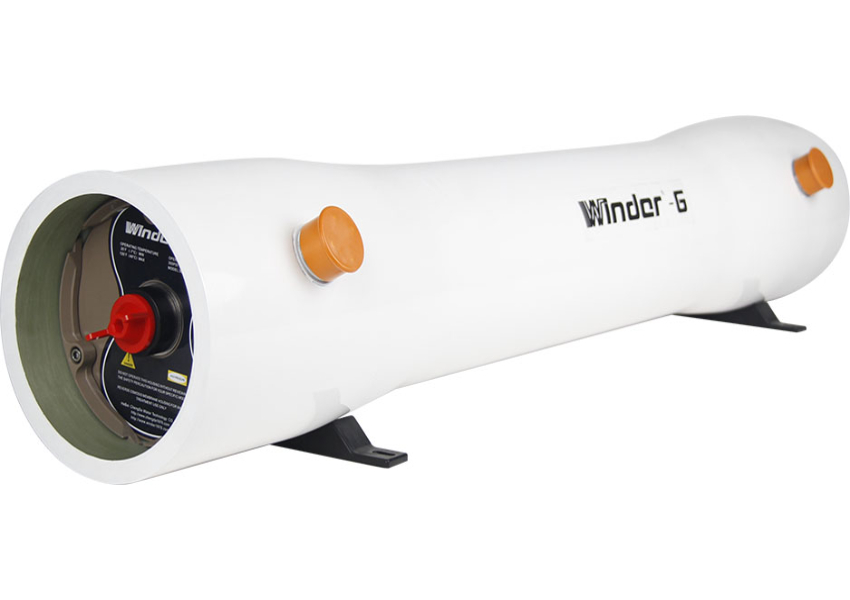
The membrane housing is a mechanical part of that treatment boundary. Hedlon’s 8-inch side-contact RO membrane housing product family is listed in separate lower- and higher-pressure series, with configurations for multiple membrane elements, port options, cyclic testing, and a stated operating pH and temperature range. The exact pressure class, element count, ports, and materials still need to match the selected membrane and the project design.
For the listed 8-inch side-port series, the low-pressure models cover 300, 450, and 600 PSI, while the high-pressure series extends from 1000 to 2000 PSI. It has one to eight membrane elements, a pH range of 3-11, an operating temperature range of -10°C to 66°C, feed or concentration ports from 1.5 to 3 inches, and 100,000 cyclic pressure tests. These are housing specifications, not PFAS removal results.
Activated Carbon for Targeted Adsorption
Activated carbon is commonly evaluated when adsorption is practical and the water does not consume bed capacity too quickly. The media choice, empty-bed contact time, flow distribution, bed depth, and organic background all matter. Carbon can be a useful primary or polishing stage, but breakthrough monitoring and spent-media handling are part of the process, not afterthoughts.
Ion Exchange for Selective Polishing
Ion exchange PFAS treatment depends on the resin’s selectivity, capacity, particle size, contact conditions, competing ions, and regeneration or disposal route. It can fit a compact polishing stage or a treatment train that needs a different selectivity from carbon. Resin selection should be based on representative water and a defined exhaustion criterion, not only on a generic PFAS label.
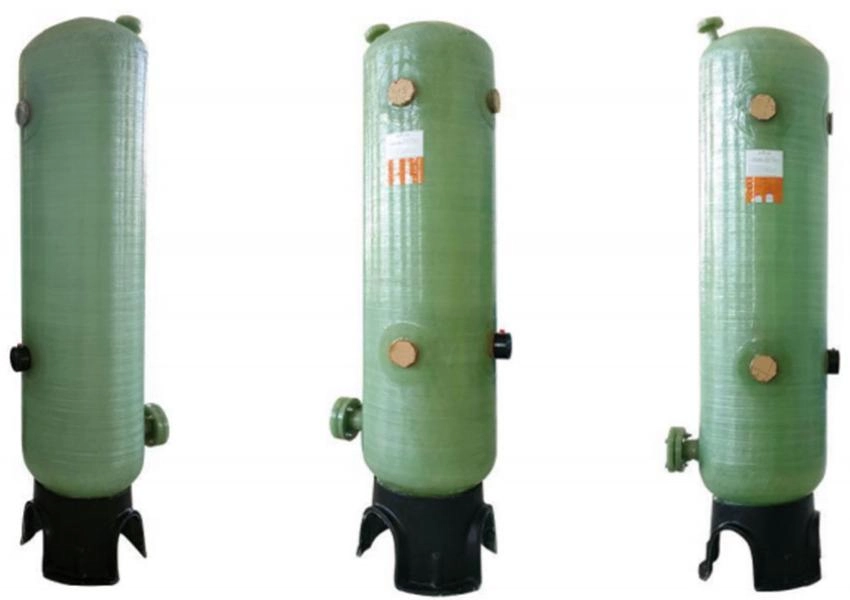
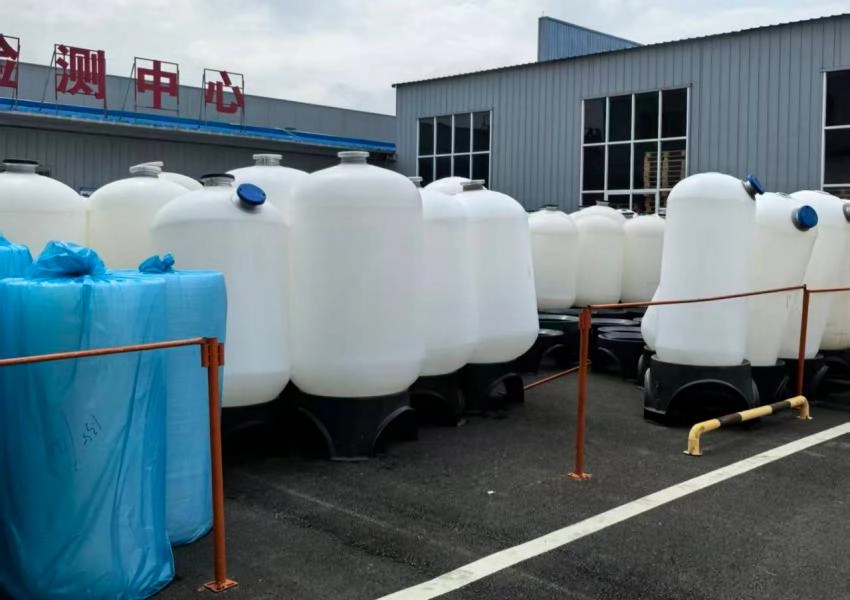
The FRP ion exchange tank is described with resin and fiberglass winding, corrosion resistance, lightweight, high strength, leak-proof performance, and customized openings. The specified ion-exchange column or mixed-bed design also uses a vertical triangular base connection. The project information lists a product-water resistivity above 10 MΩ·cm when influent conductivity is below 5 μS/cm; that statement belongs to the specified water-treatment condition and is not a PFAS removal guarantee.
Pretreatment Protects the Chosen Process
Pretreatment Before RO
An RO train may need particulate removal, antiscalant or softening decisions, dechlorination where membrane chemistry requires it, and a cleaning strategy. The membrane housing should allow the selected elements to be installed and serviced without confusing the feed, concentrate, and permeate connections. Pressure drop, recovery, cleaning chemicals, and shutdown conditions should be reviewed together.
Pretreatment Before Carbon or Resin
Carbon and resin beds need even distribution, a manageable solids load, and a clear response to breakthrough. A prefilter can protect the bed from visible solids, but it does not prove that organic matter or competing ions are under control. That distinction matters in a PFAS filtration train. Where regeneration is proposed, the water balance must include chemical storage, rinse water, neutralization, and the resulting waste stream.
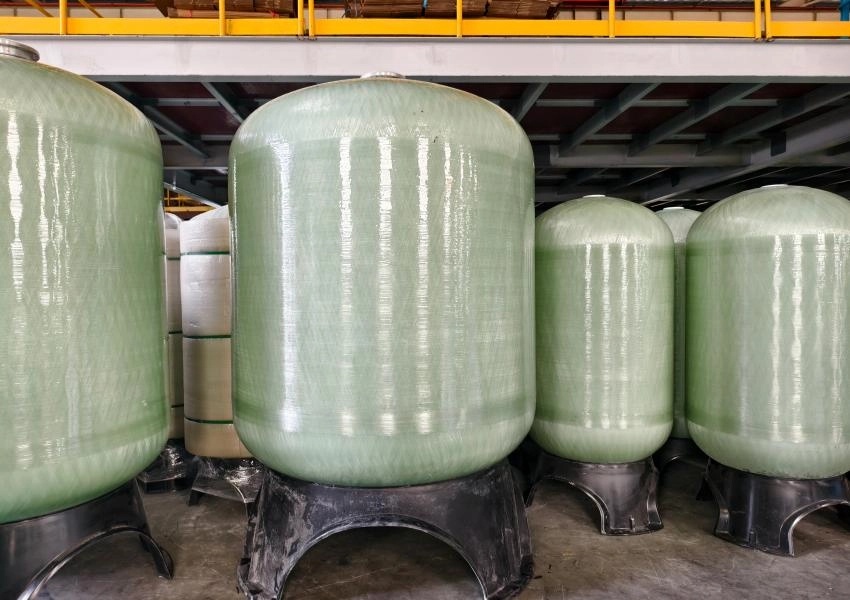
The FRP water treatment tanks are a relevant starting point for filtration or media vessels around a PFAS stage. Match openings, distributors, drains, liners, and connections to the selected media and cleaning method.
Compare Waste, Verification, and Maintenance Before Buying
The treatment method changes the waste question. RO sends PFAS and other rejected constituents into concentrate. Carbon stores the captured compounds in spent media until the media is treated, regenerated, or disposed of. Ion exchange creates exhausted resin and may create a regenerant stream. The permitted handling route, transport classification, disposal vendor, and sampling requirements should be known before the equipment is ordered.
What To Verify In The Water
A PFAS removal system should have influent, intermediate, treated-water, and waste-stream sampling points where the risk assessment requires them. Sampling frequency should reflect loading, flow, bed age, membrane condition, and the consequence of breakthrough. A single commissioning sample cannot define a long operating interval.
The procurement file should identify the target PFAS list, reporting limits, laboratory method, sample preservation, quality controls, and action levels. Do not accept a removal percentage without the compound list, influent concentration, water matrix, test duration, and detection limit behind it.
Maintenance and Operator Burden
RO maintenance centers on pretreatment, pressure and flow trends, cleaning, membrane replacement, and concentrate control. Carbon maintenance centers on bed life, channeling, backwash or replacement, and breakthrough. Resin maintenance adds exhaustion tracking, possible regeneration, resin replacement, and chemical handling. The best choice is often the one the site can monitor and service consistently.
For an FRP tank, confirm the liner, structural winding, wetted fittings, distributor, openings, drainability, pressure or vacuum limits, and cleaning compatibility. The product information for FRP treatment vessels describes corrosion resistance, high strength, leak-proof performance, and customized openings, but those properties still need to be matched to the actual water and chemical duty.
Choose the Treatment Train, Not Just the Media
A practical PFAS water treatment train may use one process as the primary barrier and another as a polishing or verification stage. RO followed by carbon can address different risks from carbon followed by RO. Ion exchange may be added where resin selectivity and waste handling are acceptable. The right arrangement depends on the water analysis, target compounds, discharge route, footprint, operator capability, and validation plan.
The RFQ should request a process flow diagram, mass balance, design basis, media or membrane specification, housing and tank drawings, sampling plan, cleaning or regeneration method, waste assumptions, spare-parts list, and acceptance test. Hedlon can be reviewed with those documents when the package needs both RO membrane housings and FRP ion-exchange vessels.
FAQ
Q1: Is RO always better than activated carbon for PFAS treatment?
A1: No. RO may provide a broad barrier, while carbon can be practical for selected compounds and operating conditions. Recovery, concentrate handling, breakthrough risk, and site capability decide the fit.
Q2: Can ion exchange remove every PFAS compound?
A2: No universal claim is safe. Resin selectivity, competing ions, organic matter, contact conditions, and exhaustion criteria must be verified with representative water.
Q3: What should a buyer request from a PFAS treatment supplier?
A3: Request the design basis, compound list, test conditions, sampling plan, housing and tank drawings, waste route, maintenance schedule, and acceptance criteria. Treat unverified removal rates as incomplete evidence.