
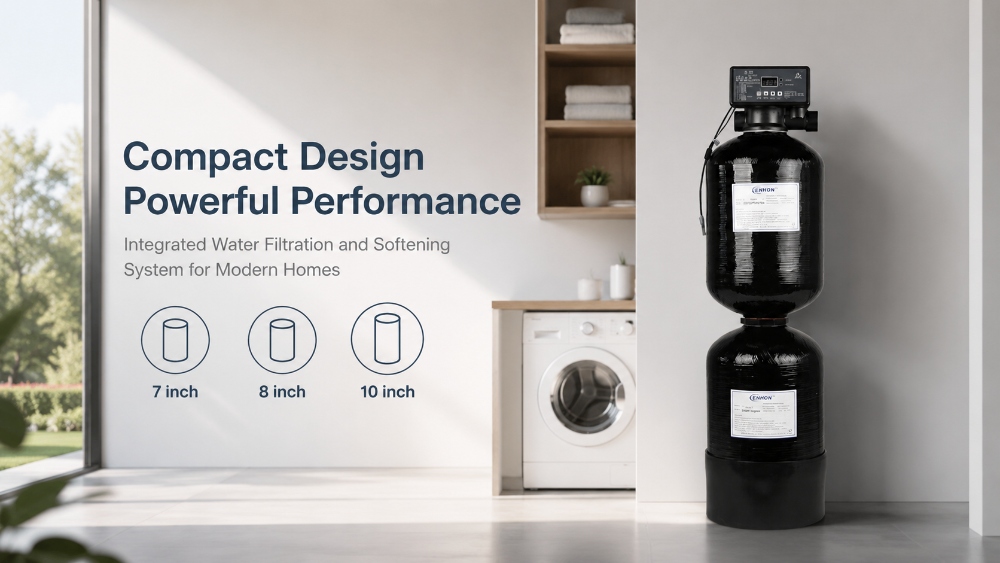
Modern homes need water treatment systems that do more work in less space. A single household may need sediment reduction, cleaner-tasting water, hardness control, appliance protection, and a layout that fits inside a garage corner, utility closet, balcony cabinet, or small equipment room. When every square meter matters, a large multi-tank setup can become difficult to install and harder to maintain.
An integrated water filtration and softening system offers a more practical direction. Instead of separating filtration and softening into different vessels, it brings multiple treatment functions into one organized structure. This can help homeowners, apartment projects, and small commercial users build a cleaner water treatment layout without filling the available space with separate tanks, pipework, and service gaps.
Why Space-Saving Water Treatment Matters in Modern Homes
Modern residential design often leaves less room for mechanical equipment. Apartments, compact villas, townhouses, cafés, salons, and small offices may all need stable water quality, but they rarely have a large dedicated equipment room. This creates a real challenge for installers and buyers: the system must treat the water properly while still fitting the site.
A traditional water treatment setup may include a filter tank, a water softener tank, a brine tank, a control valve, distributors, and connecting pipes. Each part needs installation space and service access. When these parts are spread across a small room, the system may become crowded before it even begins operation.
Separate tanks increase layout pressure
The size of one tank is not the only concern. The total footprint also includes pipes, valves, joints, drain lines, bypass areas, and maintenance space. If filtration and softening are handled by separate vessels, the installer must plan more connections and more turning space around the equipment.
This can make the system harder to inspect later. A compact water purification system helps reduce this pressure by combining treatment stages in a smaller layout. For modern homes, this is often the difference between a system that fits neatly and one that creates long-term inconvenience.
Water quality needs are becoming more complex
Many users do not need simple filtration alone. Hard water, scale, sediment, chlorine odor, and appliance protection may appear in the same project. A practical system should answer these needs in a logical order, not simply add more equipment.
Filtration can help reduce particles or improve general water quality before the softening stage. Softening then targets hardness minerals that cause scale in pipes, heaters, shower fixtures, and appliances. When water purification and softening are planned together, the system can be more efficient and easier to manage.
What an Integrated Water Filtration and Softening System Does
An integrated water filtration and softening system combines different water treatment stages within one structured unit. Instead of placing each function in a separate tank, the design allows water to pass through separated treatment areas in a planned sequence.
This approach does not remove the need for proper water testing or system design. The value is in using space more wisely while keeping the treatment process organized. For homes and small commercial spaces, this can reduce installation complexity and improve the overall equipment layout.
Purification and softening should follow a clear sequence
Filtration and softening are not the same process. Filtration is usually used to reduce suspended matter, support pretreatment, or improve water clarity. Softening is used to reduce hardness and limit scale formation. These functions work best when their roles are clearly separated.
In a compact layout, this sequence becomes especially important. If media are placed without separation, maintenance may become harder, and performance may become less predictable. A better design keeps treatment stages organized so each medium can do its own job.
Separated media make maintenance easier
Different filter media may have different functions and replacement cycles. Some media focus on particles, while others support softening or other treatment needs. If all media are mixed together, service work may become inefficient.
A multi-stage water treatment tank with isolated media areas helps solve this issue. It allows each treatment layer to remain in its proper zone. Independent filter media replacement also helps reduce unnecessary disturbance during maintenance, which is useful for homes, apartments, and small commercial equipment rooms.
How an FRP Water Treatment Tank Helps Reduce Footprint
Tank structure plays a major role in space-saving system design. The vessel must support pressure operation, resist corrosion, and remain practical for daily water treatment use. This is why an FRP water treatment tank is widely used in compact water treatment equipment.
FRP, or fiberglass reinforced plastic, combines strength with corrosion resistance and lighter weight. In residential and light commercial systems, these features can help simplify transport, installation, and long-term service planning.
One vessel can reduce the number of separate tanks
The main space-saving advantage comes from integration. Instead of arranging multiple vessels across the floor, one vertical vessel can support more than one treatment function. This can help free up space in utility rooms, laundry areas, garages, and small equipment cabinets.
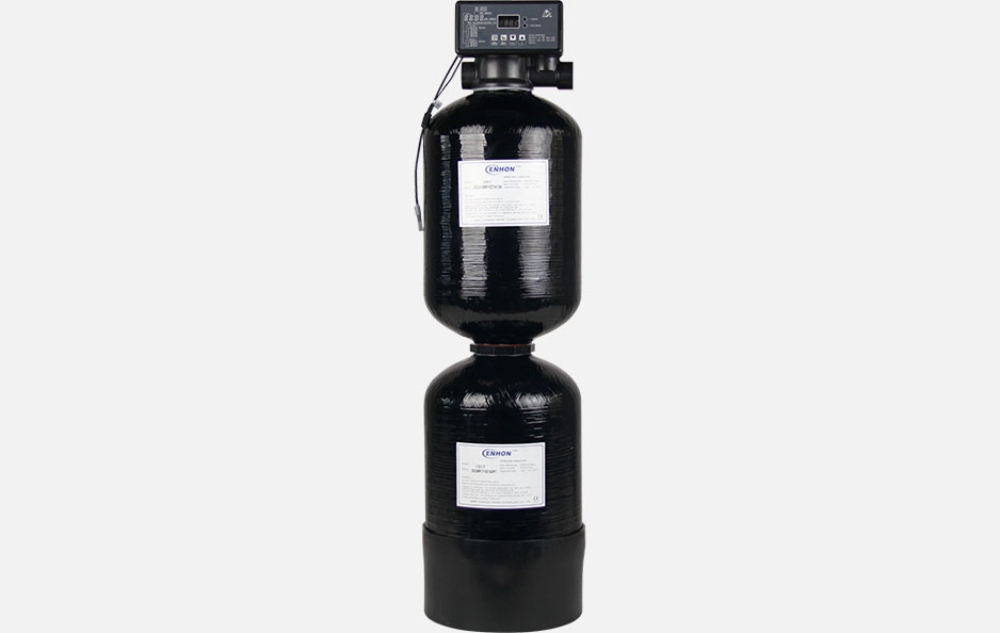
The Central Integration FRP Composite Tank Series is designed for this type of compact layout. The 7-inch, 8-inch, and 10-inch FRP composite tanks use top and bottom openings with internal partitioned isolation and communication technology. This allows purification followed by softening in one tank while keeping the filter media isolated and independently replaceable.
Fewer external connections can make installation cleaner
A smaller number of vessels can also mean fewer pipes, joints, and connection points. This does not remove the need for professional installation, but it can make the layout cleaner and easier to inspect.
For buyers, this matters because crowded systems are often difficult to service. A cleaner layout helps technicians check valves, pipes, and media access more efficiently. It also reduces the risk of designing a system that looks acceptable on paper but becomes awkward after installation.
Why FRP Composite Pressure Tanks Suit Water Treatment Systems
A compact design still needs reliable performance. Water treatment vessels must handle pressure changes, resist corrosion, and remain stable during repeated use. An FRP composite pressure tank can meet these needs while supporting a lighter and more compact system structure.
The material choice is especially important in water treatment because tanks may face varying water quality, dissolved minerals, and long service periods. A strong vessel helps protect both the system and the user experience.
FRP supports corrosion resistance and lower handling difficulty
Compared with many metal vessels, FRP offers strong corrosion resistance in water treatment environments. It is also lighter, which can make transportation and positioning easier during installation.
Hedelong FRP composite tanks use a food-grade HDPE liner and epoxy resin with fiberglass winding reinforcement. This structure supports water-contact suitability, strength, and durability in residential and light commercial treatment systems.
Pressure performance should match the application
Pressure stability is an important selection factor. Hedelong FRP composite tanks include working pressure options such as 125 psi and 150 psi. The tank series also includes more than 100,000 cyclic pressure fatigue tests and burst pressure testing at four times the design pressure.
These figures help distributors, installers, and project buyers evaluate whether a tank is suitable for the intended system. A compact layout should never be selected by size alone. Tank diameter, connection type, pressure rating, media design, and expected flow demand should all be reviewed before purchase.
What Buyers Should Check Before Choosing a Compact System
A compact system can save space, but smaller does not always mean better. The right choice depends on the water problem, flow demand, installation space, and maintenance plan.
Before choosing a water softener tank or integrated filtration unit, buyers should review site conditions carefully. This reduces the risk of buying a system that fits the room but fails to meet daily water needs.
Test the water before selecting the system
Hardness is only one possible issue. A water sample may also show sediment, odor, iron, high mineral content, or other concerns that affect media choice. The system should be designed around actual water conditions, not assumptions.
If scale is the main concern, softening may be the priority. If particles or odor are present, filtration may need more attention. When both issues appear together, an integrated water filtration and softening system can provide a more space-efficient answer.
Leave enough room for future service
A compact water purification system still needs maintenance access. Media replacement, valve inspection, pipe checking, and cleaning all require working space. If the equipment is installed too tightly, later maintenance can become expensive or inconvenient.
This is why separated media and independent replacement are valuable. They help technicians service the system without unnecessary disruption. For small equipment rooms, this practical detail can matter as much as the original footprint.
Match the tank with the project scale
The selected tank should match the flow demand and treatment purpose. A home with moderate daily use, a small café, and a light commercial space may all need different configurations. The tank volume, opening design, and internal structure should match the expected use.
For buyers comparing a standard FRP water treatment tank with an integrated model, the main question is simple: does the project need one treatment function, or does it need multiple stages in a smaller space?
Where Integrated Systems Work Best
Integrated systems are not meant to replace every type of water treatment layout. Large industrial plants or special process water projects may require larger customized equipment. However, for modern homes and small commercial sites, the benefits can be clear.
An integrated system works best where water quality needs are layered, but the installation area is limited. It can help reduce system footprint, simplify installation planning, and make the equipment room easier to manage.
Modern homes and apartments
Homes with compact utility areas can benefit from a single-vessel design. A water softener tank combined with filtration stages can help reduce the need for separate tanks while still addressing hardness, sediment, and general purification needs.
Small commercial spaces
Cafés, salons, offices, and small service spaces may need better water quality for equipment protection, cleaning, washing, or customer experience. In these settings, a compact system can support daily use without requiring a large equipment area.
Hedelong supplies FRP tanks, membrane housings, brine tanks, dosing tanks, water storage tanks, and related water treatment equipment. For compact projects, the tank and matching components can be planned around actual installation conditions.
Project and OEM support
Distributors, equipment builders, and project contractors may also need support beyond one standard tank. Custom sizes, logos, packaging, pressure testing, and component matching can all affect project delivery.
Our OEM and ODM manufacturing support helps buyers evaluate tank options, accessory matching, and project requirements. This is useful when a compact system needs a tank, valve, distributor, brine tank, fittings, or related parts from one supply chain.
Conclusion
Space-saving water treatment is not only about using a smaller tank. It is about organizing filtration, softening, pipework, and maintenance access in a smarter way. Modern homes and small commercial spaces often need better water quality, but they cannot always support a large multi-tank system.
A suitable FRP composite pressure tank can reduce the system footprint while supporting corrosion resistance, stable pressure performance, and practical installation. When purification and softening are combined in one separated structure, users can gain a cleaner layout without losing the logic of multi-stage treatment.
For projects with limited space and layered water treatment needs, an integrated tank design can be a practical option. To review tank size, connection design, and compact system requirements, speak with our team for water treatment tank selection support.
FAQ
Q: What is the main benefit of an integrated water filtration and softening system?
A: The main benefit is space efficiency. It combines filtration and softening functions in one structured unit, reducing the need for multiple separate tanks and a larger installation area.
Q: When should buyers choose an FRP water treatment tank?
A: Buyers can choose an FRP water treatment tank when corrosion resistance, lighter weight, and stable pressure performance are important for residential or light commercial water treatment systems.
Q: Is a compact water purification system suitable for small commercial spaces?
A: Yes. A compact water purification system can suit cafés, salons, offices, and similar spaces when the flow demand, water quality, and installation conditions match the tank design.