


As industrial water reuse and modular treatment upgrades gain priority in 2026, more projects are moving closer attention to the pretreatment train instead of focusing only on the polishing stage. In that context, a custom FRP sand filter tank is no longer a niche item. It is often a core engineering decision, because the wrong vessel can create unstable flow, difficult maintenance, premature media problems, and avoidable pressure loss across the whole line.
For many industrial pretreatment systems, the question is not whether sand filtration is still relevant. It is whether the vessel fits the real job. A standard tank may work in a simple layout, but many sites do not have simple layouts. Existing pipe routes, restricted equipment rooms, unusual support conditions, aggressive water chemistry, and retrofit deadlines all push the design toward a custom water treatment tank rather than a catalog size. That is where a custom FRP sand filter tank becomes the more practical choice.
At Hedelong, we work in water treatment equipment and related FRP products, so we see the same pattern repeatedly: engineers rarely struggle with the filtration principle itself. They struggle with how to fit a reliable FRP pressure tank into a real project with real site limits. Our role is to help solve that mismatch without turning the article into a sales brochure. The right answer is usually structural and operational before it is commercial.
Why standard vessels often fall short in industrial pretreatment
Sand filtration remains one of the most practical steps in industrial pretreatment because it protects downstream equipment, reduces suspended solids load, and stabilizes system performance before carbon adsorption, softening, membrane separation, or polishing. Yet the vessel that holds the media determines whether that duty stays reliable over time. A poor tank choice can cause uneven loading, awkward maintenance access, and difficult integration with valves, distributors, and existing pipework.
Space, piping, and layout are usually the first constraint
Many pretreatment upgrades happen in brownfield conditions rather than empty new-build facilities. The plant already has columns, pumps, cable trays, drain channels, and fixed inlet and outlet lines. In those situations, a generic fiberglass sand filter tank may fit on paper but still fail during installation. Height may be wrong for media loading. Footprint may block service access. Standard nozzle positions may force unnecessary elbows or extra supports. A custom FRP sand filter tank helps avoid those compromises because geometry and connection layout can be designed around the actual skid or room.
The vessel must also match the media duty
Industrial pretreatment rarely treats one clean, stable water source all year. Feed quality can shift with production cycles, seasonal changes, or source blending. That places more pressure on the vessel, not just the media bed. In this setting, the value of an FRP pressure tank comes from corrosion resistance, stable structure, low transport burden, and a better fit for non-standard connection points. When the vessel matches the duty, the media performs more consistently and the whole pretreatment stage becomes easier to operate.
What to evaluate before choosing a custom FRP sand filter tank
Choosing a custom tank should not begin with brand preference. It should begin with a technical checklist. The strongest projects usually define the vessel around process duty, installation conditions, and long-term service requirements before discussing appearance or price.
1. Tank shape and footprint
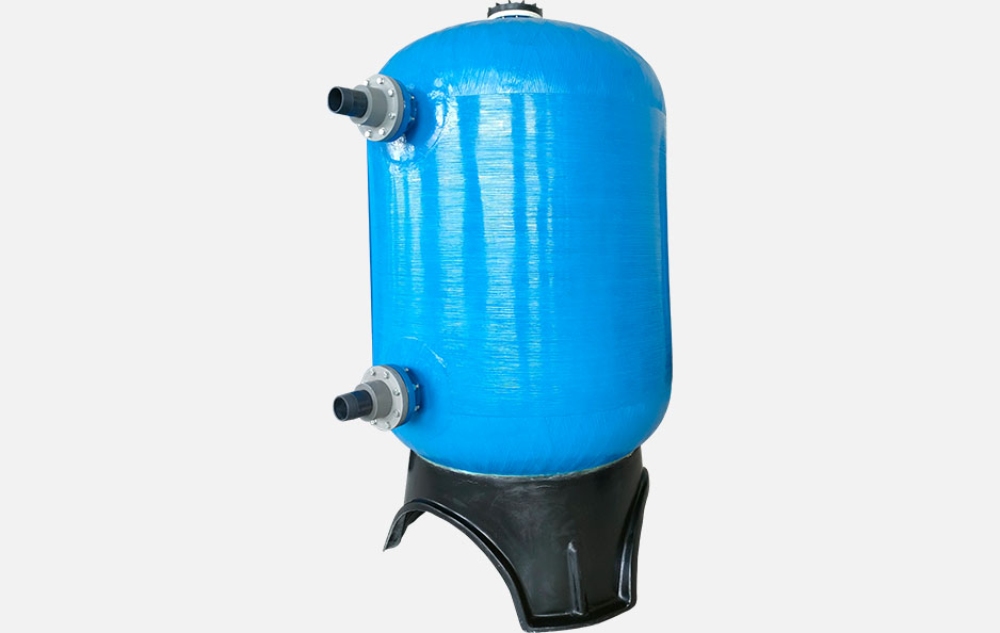
The first question is simple: what shape can the room actually accept? Some projects need a vertical foot design. Others need a flat bottom, a horizontal saddle, or another special support arrangement. A custom water treatment tank should reduce structural conflict, not create it. Hedelong’s FRP special shape custom pressure tank series is built around that principle. It covers custom sand filter, softening, reaction, and carbon filter configurations, with tailored opening connections and support bases for project-specific layouts.
A practical footprint review should answer five points before fabrication starts: available height, door and lifting limits, support type, operator access for loading and unloading media, and pipe approach direction. When those points are solved early, the tank becomes easier to install and easier to maintain. When they are ignored, even a sound filtration design can become expensive to commission.
2. Connection layout and media loading
Connection design matters more than many buyers expect. A vessel that fits the room but complicates loading, unloading, or valve access is still a poor choice. For industrial pretreatment, opening size, flange or thread type, top or side entry, and distributor compatibility all influence service life and downtime. A custom FRP sand filter tank should support a loading and discharge method that suits the real maintenance routine, not an idealized sketch.
This is one reason custom vessel design has gained ground in industrial water reuse and retrofit work. Media replacement must be safe and efficient. Valve assemblies should remain accessible. The flow path should stay clean rather than overly crowded. A vessel with the right openings and supports reduces unnecessary strain on technicians and lowers the chance of future modification work.
3. Mechanical duty and lifecycle reliability
Many buyers compare tanks only by diameter and nominal volume. That is not enough. An FRP pressure tank has to be judged by operating pressure, temperature range, structural stability, and how it will behave after repeated service cycles. In industrial pretreatment, a vessel often lives in a routine of backwash, rinse, and steady filtration, so fatigue resistance and sealing quality matter as much as the initial pressure rating.
A strong corrosion resistant pressure vessel also protects lifecycle cost. Transport is easier because FRP is lighter than many metal alternatives. Installation is simpler in constrained rooms. Long-term exposure to water treatment media and process conditions is more manageable when the material system is chosen correctly. Those advantages become more valuable in modular systems, skid packages, and phased expansions where future access is never as open as the original drawing suggests.
Why FRP is often the better material for pretreatment duty
For many industrial pretreatment applications, the real comparison is not custom versus standard. It is FRP versus conventional metal. That comparison should focus on operating reality rather than purchase habit.
Corrosion resistance and weight change the project economics
A steel vessel may appear familiar, but familiarity does not guarantee the best fit. In many pretreatment environments, corrosion risk, transport burden, and site handling cost make FRP the stronger option. A properly designed water treatment tank in FRP offers a combination that is hard to ignore: corrosion resistance, high strength relative to weight, good impermeability, easier transportation, and easier installation. These are not cosmetic advantages. They affect crane choice, manpower, access planning, and future replacement cost.
Custom fabrication is more valuable in retrofit work
A standard metal vessel may force the rest of the skid to adapt to it. A custom FRP sand filter tank can do the opposite. It can adapt to the skid, the floor, the pipe route, and the maintenance pattern. That is especially important in retrofit work, where the pretreatment stage must often be improved without rebuilding the entire room. In those jobs, a fiberglass sand filter tank with customized openings and support bases can solve a layout problem that no standard unit can solve cleanly.
This is also why the best buyers evaluate the vessel as part of the whole process train. If the tank reduces future shutdown hours, simplifies media service, and protects downstream units, then it carries value well beyond the shell itself. That is the correct way to judge a custom water treatment tank in B2B projects.
Where a custom FRP sand filter tank creates the most value
A shaped or non-standard vessel is not required for every site. It becomes valuable when the process and the installation environment move away from standard assumptions.
Industrial water reuse and process retrofit
Industrial water reuse is one of the clearest examples. Reuse projects often combine existing civil works, legacy pipe elevations, and new process targets. Pretreatment becomes more demanding because the feed stream is less predictable and downstream units are more sensitive. In those cases, a custom FRP sand filter tank gives engineers more control over connection points, support layout, and service access while keeping the pretreatment step compact and reliable.
Centralized commercial systems and multi-media filtration
The same logic applies to centralized filtration in large commercial buildings, hospitality projects, and similar systems that need stable pretreatment in a tight equipment space. Multi-layer media arrangements can benefit from a vessel designed for the room instead of a vessel that merely fits the process flowrate. When the tank footprint, opening style, and support structure are aligned with the site, the result is a more maintainable industrial pretreatment package.
Aquaculture and other corrosion-sensitive duties
Aquaculture and related filtration duties also show why FRP remains relevant. These systems often need corrosion resistance and low maintenance along with reliable flow. A corrosion resistant pressure vessel with tailored dimensions can meet those needs without the handling penalties that come with heavier materials. Hedelong’s custom series is already used across water treatment applications such as industrial multi-layer media filtration, water softening, centralized filtration, and aquaculture filtration, which makes it a practical reference point when a project demands a shaped vessel rather than a standard tank.
How we recommend making the final choice
In our experience, the best buying decision does not start with the lowest quote. It starts with the clearest process definition. Before ordering any custom FRP sand filter tank, we recommend locking down the following points:
Process checklist before RFQ
-
design flow and filtration rate
-
media type and bed depth
-
normal and peak operating conditions
-
available installation space
-
required inlet and outlet orientation
-
support style
-
loading and unloading method
-
future maintenance access
-
downstream equipment sensitivity
-
expansion or retrofit plans
Once those points are fixed, the right FRP pressure tank becomes easier to specify. The supplier can align the shell design, the opening arrangement, and the support configuration with the process instead of forcing the project to compromise.
That is also where manufacturer capability starts to matter. We keep that part brief because buyers care more about execution than slogans. Still, it matters that the supplier can support OEM and ODM work, small-batch trial orders, factory pressure testing, export packaging, installation guidance, and spare parts supply. When a project reaches procurement stage, those services often decide whether the equipment arrives as a usable solution or just a vessel. Our service approach includes those support items because pretreatment equipment has to perform in the field, not only in a quotation sheet.
Conclusion
A custom FRP sand filter tank is the right choice when the process layout, maintenance method, or installation limits make a standard vessel inefficient. That is increasingly common in industrial pretreatment, especially where industrial water reuse, retrofit integration, and compact skid design are pushing tanks into more demanding roles. The key is to choose a vessel that matches the room, the piping, the media duty, and the long-term operating plan rather than treating the tank as a generic commodity.
When that match is correct, the pretreatment stage becomes easier to install, easier to service, and more reliable over time. We recommend starting with the process checklist, then reviewing footprint, supports, connection layout, and maintenance access before finalizing the vessel. If your project needs a shaped water treatment tank rather than a standard shell, a focused technical review will save far more than it costs. When the design is ready, contact us.
FAQ
Q: When is a custom FRP sand filter tank better than a standard tank?
A: It is better when the site has limited space, unusual pipe routing, non-standard supports, difficult media loading access, or a retrofit condition that makes a catalog size inefficient.
Q: Why is FRP often preferred over steel for industrial pretreatment?
A: FRP combines corrosion resistance, lower weight, good structural strength, and easier installation. In many pretreatment projects, those traits improve lifecycle value more than a familiar metal shell.
Q: What information should be prepared before requesting a quotation?
A: Prepare design flow, media type, operating conditions, footprint limits, nozzle orientation, support requirements, maintenance access needs, and any downstream sensitivity. That information leads to a more accurate custom tank design.