

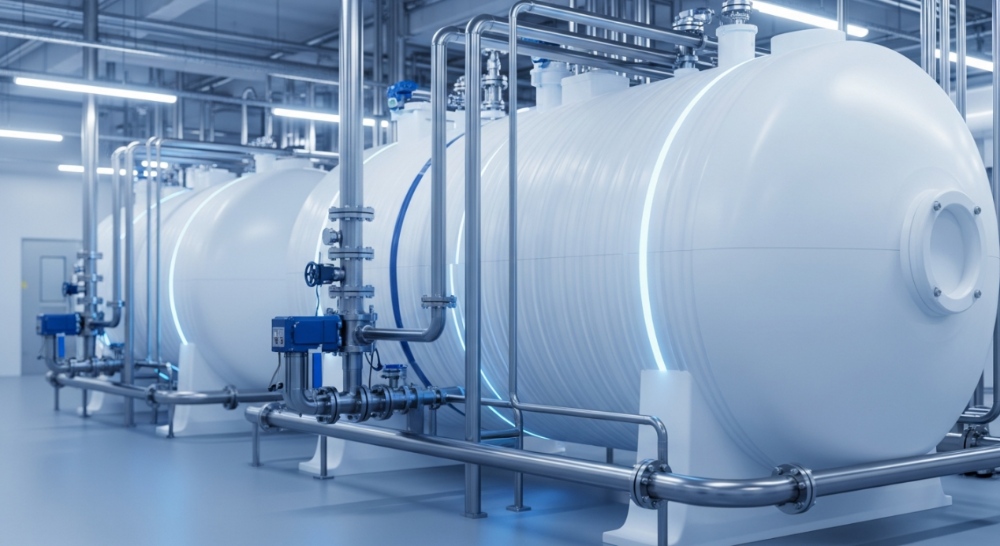
Finding flawless water quality is no longer just a goal for modern facilities—it is a strict baseline. Think about semiconductor fabs, pharmaceutical plants, or advanced power generation sites. These sectors depend completely on fluids meeting highly stringent resistivity thresholds for ultra-pure water. Getting the water to that state is hard enough. Keeping it there during storage is where the real engineering headaches begin. Standard storage options usually fall short here. Even high-grade alloy containers deal with microscopic leaching or slow corrosion over time. Standard plastics? They simply break down when subjected to chemical stress or extreme temperature swings.
The biggest threat, though, is the air itself. The second a high-resistivity fluid touches ambient air, it pulls in carbon dioxide and airborne particles. The purity matrix drops instantly. We watched this vulnerability cause massive losses across the industry. That is why Hedelong spent decades developing a definitive fix for fluid isolation. Our focus shifted entirely toward containment systems built around absolute hygiene and long-term structural integrity.
The Hidden Cost of Secondary Pollution in Ultra-Pure Water Storage
How Air Contact Degrades Water Quality
Atmospheric exposure ruins highly refined fluids almost immediately. The air around us is packed with trace chemical vapors, micro-particles, and bacteria. Stripped of its natural ions, ultra-pure water essentially acts as a hungry solvent. It aggressively pulls impurities right out of the air to find a new equilibrium. You will see a sudden, sharp drop in resistivity alongside spiking conductivity. If your facility runs on precise chemical balances, this invisible contamination renders the entire tank useless for sensitive applications.
Financial Repercussions in Industrial Production
Ignoring secondary pollution prevention does not just hurt water metrics; it creates massive financial leaks. Take microelectronics: a tiny variance in water purity ruins entire silicon wafer batches. The scrap costs are staggering. In pharmaceutical manufacturing, biological contamination from a poor storage setup violates strict compliance rules. The result? Stopped production lines and expensive, full-system sanitizations. Putting capital into specialized water treatment equipment is not a luxury upgrade. It is a mandatory step to protect the massive investments already made in high-purity water preparation. You need storage tech that physically locks the external environment out completely.
How Nitrogen-Sealed Technology Stops Contamination
Automated Pressure Control and Fluid Isolation
Significantly minimizing atmospheric exposure is critical to maintaining stringent purity standards. We achieve this through advanced nitrogen separation technology. By pumping inert nitrogen gas into the top headspace of the vessel, the system creates a highly effective protective barrier against the outside environment. The process runs on automated precision. When the liquid level drops during daily operations, automatic inlet valves inject more nitrogen to fill that empty space. This stops outside air from pulling inward. When the vessel fills back up, outlet valves safely release the displaced nitrogen. This regulated pressure loop substantially minimizes the risk of oxidation and airborne contamination.
Advanced Dual-Layer Material Construction
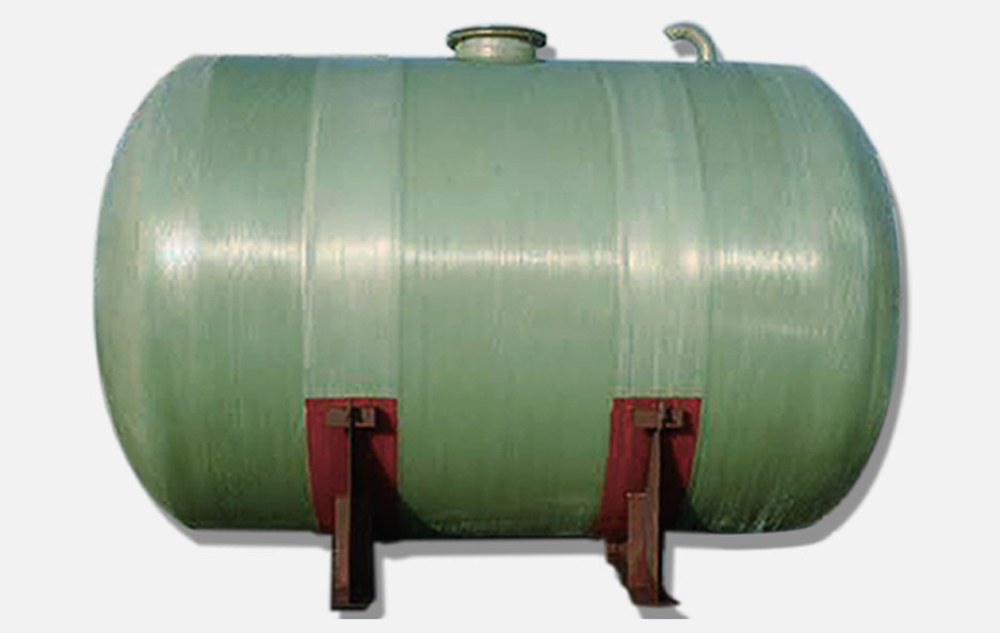
The physical build of the containment vessel matters just as much as the gas barrier. Look at the FRP tank/nitrogen sealed tank. We designed it using a highly specialized dual-layer layout. Inside, you will find a sanitary-grade sheet material liner. It provides a smooth, non-toxic surface that never leaches chemicals or drops particulates into your stored medium. On the outside, we reinforce the structure with premium fiberglass winding embedded directly in epoxy resin. This composite method creates a lightweight but incredibly strong tank with excellent acid and alkali resistance. Plus, the thermal conductivity of this specific fiberglass setup is remarkably low—about 1/200th that of standard metal. That thermal insulation shields the internal fluid from harsh external temperature swings.
Top Criteria for Choosing the Best Storage Tanks in 2026
Extreme Durability and Temperature Resistance
Longevity and environmental toughness should lead your evaluation when hunting for the best FRP tanks for industrial applications. Facilities run in wildly different climates and under tough process conditions. We engineer our vessels to handle demanding environmental extremes. They are designed for exceptional thermal stability, performing reliably across fluctuating industrial temperature ranges. Even in cold conditions, the specifically formulated composite material maintains excellent impact resistance without turning brittle. Under specified pressure and operational conditions, these vessels are designed to deliver an extended service life, changing the return on investment math for industrial infrastructure. That kind of longevity changes the return on investment math for industrial infrastructure.
Custom Water Storage Solutions and Scalability
No two plants share the exact same floor plan or volume needs. Buying from a standardized catalog often forces your engineers into bad layout compromises. We focus heavily on authentic custom water storage solutions to fix this. Our standard configurations cover total volumes from 0.5m³ up to 40m³, using standard DN sizes from DN15 to DN80. But for massive centralized sites, we build fully custom units featuring diameters of 3.5m and above. These custom builds seamlessly integrate with your required accessories, whether that means specific high-precision liquid level gauges or unique water/nitrogen port layouts.
Stringent Quality and Safety Certifications
In high-stakes production, a manufacturer’s quality claims need proof from verifiable global standards. A tank is only reliable if it survives extreme stress tests. Ours pass more than 100,000 cyclic pressure fatigue tests, along with burst pressure tests pushed to four times the design pressure limit. To back that up, our manufacturing flow and final products carry international ISO9001 quality management system certification, CE certification, and NSF certification. They also hold domestic hygiene license approvals, verifying their safety for heavy industrial and potable uses alike.
Versatile Applications Beyond Ultra-Pure Water
Commercial and Environmental Implementations
We originally engineered these units for the absolute strictest purity demands. Yet, the durability and hygienic nature of these multi-purpose FRP tanks make them solve problems across many fluid management scenarios. They act as the reliable backbone for centralized filtration systems in high-rise residential towers, commercial resorts, and luxury hotels, securing a clean drinking water supply. They also align with the push toward eco-friendly industrial water solutions. The construction utilizes eco-friendly, recyclable materials, directly helping facilities lower their operational carbon footprint.
Specialized Filtration Systems
Because the composite material resists pressure and chemicals so well, handling aggressive media is not an issue. Engineers frequently spec them for industrial water treatment that relies on multi-layer media, a setup where different filtration layers create varying internal stresses. You will also find them doing the heavy lifting in large-scale water softening systems and grease traps. They are even a top pick for complex aquaculture filtration system setups. In massive fish farming operations, continuous high-volume flow and strict biological controls are non-negotiable. That broad adaptability makes the FRP tank/nitrogen sealed tank a vital asset for both typical commercial builds and highly specialized liquid networks.
Why Partner With Us For Your Water Treatment Projects
Picking the right vessel is just step one. Partnering with a manufacturer capable of delivering it correctly dictates how long your installation actually lasts. As a focused water treatment solution provider, we bring over 20 years of manufacturing experience directly to the global market. Our supply chain and engineering teams have successfully delivered projects to over 150 countries. Today, we hold the long-term trust of more than 600 partner clients.
Comprehensive Manufacturing and Quality Support
Large industrial projects demand precision, flexibility, and a way to lower risk. Our facilities handle extensive OEM FRP tanks manufacturing support, giving you room for complete brand and packaging customization based on your exact specs. We know evaluating new equipment carries risk. That is why we actively support sample requests and small-batch trial orders before you commit to bulk production. Before any unit leaves our loading dock, it goes through strict quality inspection and pressure testing. We ship it out with detailed sample reports and verification photos so you know exactly what is arriving.
End-to-End Project Execution
Our job does not end when the product leaves the factory floor. We manage the heavy lifting of international deployment with full packaging and export logistics support. Once the tanks hit your site, we provide deep installation guidance and after-sales training. We want your engineering teams fully equipped to keep the systems running at peak efficiency. We also maintain a dedicated spare parts and accessories supply network to ensure your facility avoids unnecessary downtime down the road.
Take Action: Secure Your Water Systems Today
Do not let a subpar containment vessel threaten your high-value production lines or trigger expensive fluid degradation. Secure your critical assets with containment tech built for absolute purity, heavy-duty thermal stability, and multi-decade lifespans. If your site needs better isolation capabilities, talk to our engineering team. Contact us to go over technical specifications, look into custom sizing for your specific floor plan, or request evaluation samples to inspect our build quality firsthand.
FAQ
Q: How does the nitrogen separation technology actively contribute to secondary pollution prevention?
A: It works by keeping a steady injection of inert nitrogen gas in the empty headspace above the fluid. Nitrogen is heavier than the ambient air and chemically inactive, so it works by keeping a steady injection of inert nitrogen gas in the empty headspace above the fluid. Nitrogen is chemically inactive, allowing it to form a pressurized, protective blanket over the stored medium. Automated valves handle the pressure regulation—venting gas as the vessel fills and injecting more when the fluid level drops. This effectively minimizes the intrusion of airborne contaminants and carbon dioxide, significantly reducing the risk of fluid degradation.
Q: What makes fiberglass reinforced plastic superior to traditional steel for high-purity water preparation?
A: Steel rusts, faces chemical corrosion, and eventually leaches heavy metals. Our composite material solves this by using a seamless, sanitary-grade inner liner that stays biologically inert and non-toxic. On the outside, the resin and fiberglass winding deliver massive structural strength. The real differentiator is the thermal conductivity, which sits at roughly 1/200th that of metal. This stops temperature swings from impacting your stored fluid and completely rules out rust or oxidation risks.
Q: Can your custom water storage solutions accommodate unique spatial constraints in older industrial plants?
A: Absolutely. Adapting to complex spatial limits is something we specialize in. We carry standard volumes from 0.5m³ up to 40m³, but our manufacturing lines can produce custom vessels with diameters of 3.5m and above. We also tailor the sizing and placement of standard DN ports (DN15 to DN80), liquid level gauges, and base mounts to fit perfectly into your existing piping and floor layout.