
Seawater desalination puts more pressure on every part of an RO skid. The pump, membrane, piping, instruments, and pressure vessel must work as one system. A housing selected only because it accepts an 8040 element can still create trouble when the pressure class, port direction, end closure, or maintenance clearance does not match the plant design.
For project buyers, the useful question is not simply whether a vessel is labeled high pressure. It is whether the 8040 RO pressure vessel has enough verified margin for the actual seawater RO system while still fitting the element count, manifold layout, cleaning routine, and spare-parts plan. That is where a product comparison becomes a procurement decision.
Why 8040 Seawater Duty Needs A Careful Vessel Check
An 8040 vessel is built around the nominal size of a large spiral-wound membrane element, but size alone does not define its duty. Seawater feed can call for much higher operating pressure than many brackish water systems. The final requirement depends on feed salinity, membrane specification, recovery target, temperature, pretreatment, pump curve, and the pressure losses across the train.
Pressure Is A System Number
The housing pressure class should be compared with normal operating pressure, maximum working pressure, start-up behavior, valve switching, flushing, and any approved cleaning condition. An 8040 high-pressure membrane vessel is one part of the pressure boundary. The pump discharge rating, fittings, connectors, end plates, instrumentation, and piping must also be suitable for the same duty. A stronger label on the shell cannot correct a weaker connection elsewhere.
Allow For The Way The Plant Runs
Seawater systems rarely operate in a perfectly steady state. Intake conditions change, filters load, pumps are adjusted, and trains may be taken offline for service. Procurement documents should state the design pressure, operating range, test basis, temperature range, water chemistry, and expected pressure fluctuations. This gives the supplier a real duty to review instead of leaving selection to a catalog shortcut.
Match The Pressure Class To The Membrane Train
The pressure class should be selected after the membrane and process design are clear. The membrane manufacturer’s data establishes the element’s operating limits. The RO system designer then adds hydraulic losses, control range, and the margin needed for the project. The vessel must be rated for the resulting pressure boundary, but the highest available rating is not automatically the right purchase.
Use The Datasheet And Pump Curve Together
A practical review starts with four numbers: normal operating pressure, maximum design pressure, test pressure, and any pressure expected during cleaning or flushing. Check these against the pump curve and the membrane train’s pressure drop. Also check whether the vessel’s test pressure is being confused with its permitted operating pressure. Those are different figures and should remain separate in the order specification.
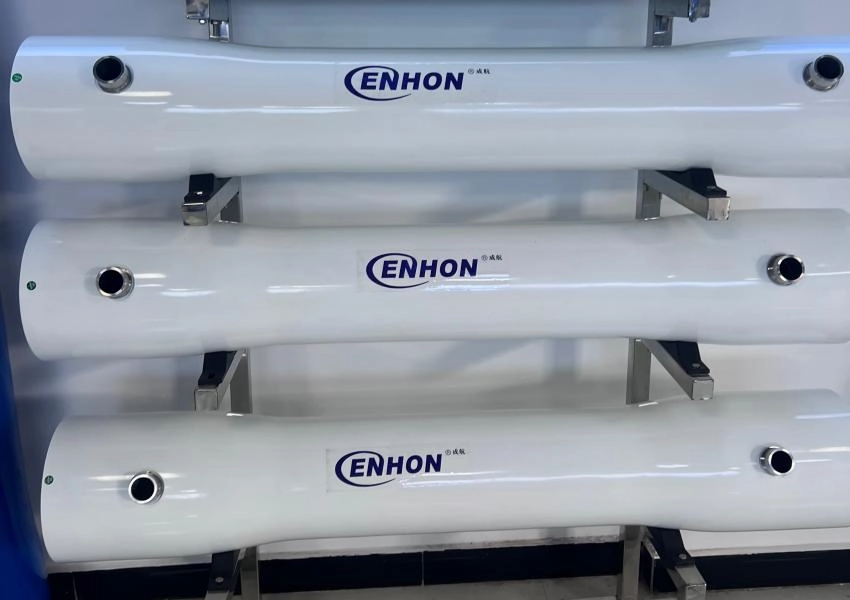
Hedelong has FRP membrane housing selections with 8040 side-port and end-port configurations, pressure classes from 150 to 1000 PSI, and lengths for one to seven or one to eight elements. The current 8-inch side-contact product page expands the listed high-pressure range to 300, 450, 600, 1000, 1200, 1500, 1800, and 2000 PSI for one to eight 8-inch elements. That range is useful for project matching, but the selected class still needs to follow the approved membrane and process calculations.
Do Not Treat 2000 PSI As A Default
A 2000 PSI desalination pressure vessel may be appropriate for a demanding high-pressure seawater layout, yet it can be unnecessary for a train designed around a lower pressure class. Overspecification adds purchase cost, handling weight, installation demands, and sometimes more expensive replacement hardware. Under-specification is more serious, so the order should show both the required duty and the reason for the selected class.
Choose Side Port Or End Port Around The Skid
Port orientation changes the way a membrane train is built, serviced, and expanded. It should be settled while the skid frame and manifold drawings are still flexible. A vessel that is technically suitable but points the feed and concentrate lines in the wrong direction can force extra elbows, reduce access, and make future element replacement slower.
Where Side Port Helps
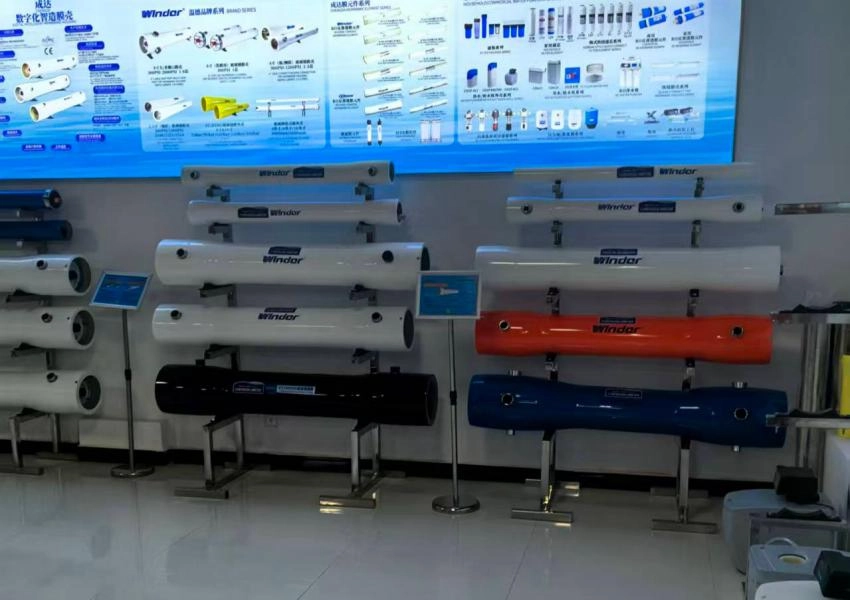
The 8-inch side-contact FRP RO membrane housing places raw-water and concentrate connections on the side of the cylinder. This arrangement can simplify parallel vessel banks and give the engineer more freedom when several housings share a header. It has compatibility with one to eight 8-inch elements, optional design pressures from 300 to 2000 PSI, raw-water or brine inlets from 1.5 to 3 inches, and a 1-inch NPT/BSP treated-water outlet.
Where End Port Helps
An end-port layout can be cleaner when vessels are arranged in line or when the piping plan is built around axial flow. The 8-inch end-to-end FRP RO membrane housing should be reviewed against the same element count, pressure, connector, and maintenance-clearance requirements. The decision is not about which port style is universally better. It is about which one leaves fewer installation compromises on the actual frame.
Review FRP Construction, Seals, And Maintenance
A seawater housing needs corrosion resistance, but that phrase should not replace a material review. The wet path includes the FRP shell, end plates, fasteners, port fittings, adapters, seals, and any internal components. Each item should be checked against the feed water, cleaning chemicals, temperature, and expected service interval.
FRP Is More Than A Shell Material
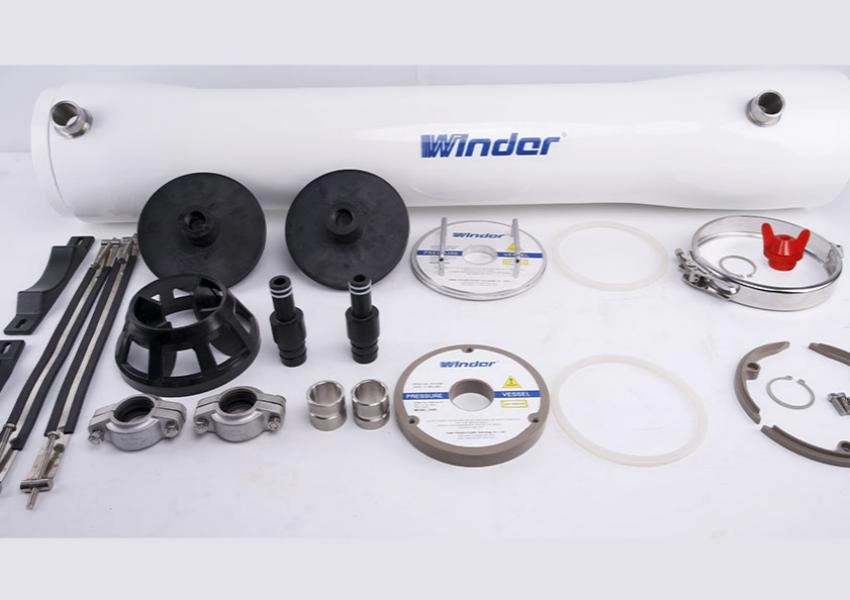
FRP construction with epoxy resin and fiber materials, while the product page identifies glass fiber-reinforced plastic and stainless steel or alloy end components. The winding and structural design used for pressure resistance and corrosion protection, along with a hydrostatic permeation test at 1.5 times the standard pressure. These details are relevant when the buyer is comparing a seawater RO membrane housing with metal alternatives, but they still need to be matched to the project specification.
Inspect The Closure Before The Order
End caps and seals deserve the same attention as the barrel. Ask how the membrane element is positioned, how the end closure is retained, which seal materials are supplied, and whether replacement seal kits can be ordered separately. Confirm the access space needed to remove an element from the longest vessel in the train. A good pressure boundary that cannot be opened safely during a shutdown is a poor maintenance choice.
Specify A Supplier Around Evidence And Repeatability
A serious purchase package should contain more than a model name and a unit price. Include the number of membrane elements, port style, port sizes, design pressure, operating temperature, feed-water chemistry, end-component material, seal requirements, color or finish, test documents, drawings, and packaging instructions. These details protect the project when several trains or several shipment batches must remain interchangeable.
What To Request Before Production
Request a dimensional drawing, connection schedule, pressure and test statement, element compatibility confirmation, closure details, inspection records, and a spare-parts list. If the vessel is being customized, approve the drawing before production. For a seawater project, also ask the supplier to identify any limits on pressure, temperature, pH, cleaning chemistry, or connector materials rather than leaving those boundaries implied.
The RO membrane housing gives buyers a starting point across 8040 and 4040 side-port and end-port selections. Hedelong also covers related FRP tanks and water-treatment accessories, which can simplify a project discussion when the vessel must be coordinated with pretreatment, brine handling, or dosing equipment. The practical value is not a broad product list. It is the ability to keep pressure, dimensions, accessories, and after-sales spares aligned from the first quotation.
FAQ
Q1: What pressure rating should an 8040 vessel use for seawater desalination?
A1: There is no universal rating. Use the membrane datasheet, pump curve, design pressure, hydraulic losses, start-up conditions, and approved cleaning limits. Then select a vessel class that covers the complete pressure boundary.
Q2: Is a side-port housing better than an end-port housing for seawater RO?
A2: Neither style is always better. Side ports often suit parallel banks and side headers, while end ports can fit an in-line or axial piping plan. The frame, manifold, service clearance, and expansion plan should decide.
Q3: What should be checked before buying a high-pressure membrane vessel?
A3: Check the pressure class, element count, port size and direction, FRP and metal materials, seals, test basis, dimensions, drawings, spare kits, and the supplier’s ability to repeat the same configuration across project batches.